Hot Water Control: The Complete Guide to Smarter Hot Water Systems
Hot water control is about more than heating water.
It is about controlling when hot water moves through a plumbing system, when a recirculation pump operates, and when that pump shuts off.
That distinction matters.
A water heater can produce plenty of hot water while someone standing at a shower, bathroom sink, or kitchen faucet still waits for it to arrive. The problem is often not the water heater itself. It is the cooled water sitting inside the hot-water piping between the heater and the fixture.
An effective hot water control system addresses that delivery problem.
Instead of simply keeping hot water circulating continuously, a demand-controlled system can circulate hot water when it is actually needed and shut the recirculation pump off after the circulation cycle is complete.
That is the principle behind D’MAND Kontrols® hot water control systems.
Quick Answer: What Is Hot Water Control?
Hot water control is the process of managing when and how a domestic hot water system circulates heated water through a building.
In a recirculation system, hot water control determines when the recirculation pump starts, how the system recognizes that hot water is needed, and when the pump stops.
Different hot water control systems use different methods.
Some rely on timers.
Some respond to water temperature.
Some continuously circulate hot water.
Some attempt to predict when occupants will need hot water.
A demand hot water control system operates in response to actual hot-water demand.
With D’MAND Kontrols®, the objective is simple:
Circulate hot water when it is needed. Stop circulating it when it is not.
Why Hot Water Control Matters
Consider what happens inside a typical house after someone finishes using hot water.
The faucet closes, but hot water remains inside the pipe between the water heater and the fixture.
Eventually, that water cools.
Hours later, someone turns the hot-water faucet back on.
The water heater may already contain hot water, but that hot water is not necessarily at the faucet. The cooled water sitting in the pipe must move out of the way before newly heated water reaches the fixture.
Without recirculation, much of that water may simply flow down the drain while the user waits.
A hot water recirculation system can address this problem by moving water through the plumbing before or while hot water is needed.
But installing a pump introduces another question:
When should that pump run?
That is where hot water control becomes important.
The pump provides circulation.
The control strategy determines how intelligently that circulation occurs.
The Five Main Ways to Control Hot Water Recirculation
Not every hot water control system works the same way.
Understanding the differences can help homeowners, builders, plumbers, property managers, engineers, and facility operators choose the right approach.
| Hot Water Control Method | What Starts Circulation | Primary Advantage | Primary Tradeoff |
|---|---|---|---|
| Continuous circulation | Pump runs continuously or for very long periods | Hot loop is regularly maintained | More pump operation and potential distribution heat loss |
| Timer control | Preset schedule | Limits operation to certain periods | Schedule may not match actual usage |
| Temperature control | Pipe or return temperature | Automatically maintains a temperature range | Can circulate when nobody needs hot water |
| Predictive/smart control | Learned or programmed usage patterns | Convenient automation | Predictions may not match changing schedules |
| Demand control | Actual request or detected demand | Runs based on real hot-water need | Requires a demand signal or activation method |
The key difference is not simply whether a system is “smart.”
It is what causes circulation to begin.
What Is Demand Hot Water Control?
Demand hot water control means the recirculation system operates in response to an actual need for hot water rather than maintaining circulation continuously.
In a residential D’MAND Kontrols® system, the user can initiate circulation through compatible activation methods such as a button, motion sensor, Bluetooth transmitter, or other configured control.
Once activated, the recirculation pump begins moving water through the plumbing.
Temperature sensing monitors the circulation cycle.
The controller then shuts the pump off after the appropriate temperature change is detected.
In simplified form:
Request hot water → start circulation → monitor temperature → stop circulation.
The purpose is not to keep every hot-water pipe heated all day.
The purpose is to prepare the plumbing for hot-water use when hot water is actually requested.
Hot Water Control vs. Hot Water Heating
These terms are related, but they are not interchangeable.
Hot Water Heating
A water heater creates hot water.
Common residential systems include:
Tank water heaters
Tankless water heaters
Heat-pump water heaters
Hot Water Control
A hot water control system manages how that hot water is distributed or circulated through the plumbing.
This distinction explains why installing a larger or newer water heater does not necessarily solve a long wait at a distant bathroom.
The heater may be doing its job perfectly.
The hot water still has to travel from the water heater to the fixture.
A properly designed hot water recirculation control system addresses that delivery process.
Why Continuous Hot Water Circulation Is Not the Same as Good Hot Water Control
It might seem logical that the easiest way to eliminate long hot-water waits is simply to circulate hot water constantly.
There is a tradeoff.
When hot water travels through piping, the piping can lose heat to its surroundings. Maintaining a hot recirculation loop for extended periods can therefore create additional distribution heat loss.
The pump also uses electricity whenever it operates.
ENERGY STAR specifically notes that recirculation systems operating continuously can potentially use more energy because of pumping energy and heat lost from the piping.
That does not mean hot water recirculation is inherently inefficient.
It means how the pump is controlled matters.
Demand control approaches the problem differently.
Instead of keeping the distribution system prepared for use all day, the pump is activated when hot water is actually requested.
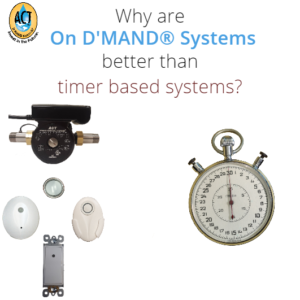
Hot Water Demand Control vs. Timer Control
Timers are one of the most common methods of controlling recirculation pumps.
A timer might operate a pump every morning from 6:00 a.m. to 9:00 a.m. and again from 5:00 p.m. to 10:00 p.m.
That can reduce pump runtime compared with uninterrupted 24-hour operation.
But a timer is still making an assumption:
Someone will probably need hot water during this period.
Real life does not always follow a timer.
Someone wakes up early.
Someone sleeps late.
The family leaves for vacation.
Guests visit.
A homeowner works from home unexpectedly.
Someone needs a shower in the middle of the afternoon.
Demand control asks a different question:
Does someone actually need hot water right now?
If the answer is no, there may be no reason to run the pump merely because the clock reached a programmed time.
Hot Water Demand Control vs. Temperature Control
Another common strategy is temperature-based control.
A temperature-controlled recirculation system can activate when water in the loop falls below a preset temperature.
This helps maintain a desired temperature within the piping.
But temperature alone does not necessarily indicate human demand.
A pipe can cool while everyone is asleep.
It can cool while the house is empty.
It can cool while nobody intends to use hot water for hours.
Demand-based control links pump operation more directly to actual use rather than pipe temperature alone.
Temperature sensing can still be extremely valuable.
In a D’MAND system, temperature information helps the controller determine when the circulation cycle should stop.
The distinction is important:
Temperature sensing can help control the circulation cycle without requiring the entire system to continuously maintain hot piping.
Hot Water Demand Control vs. Predictive “Smart” Control
Smart controls increasingly attempt to learn household behavior.
For example, a system may recognize that hot water is commonly used at 6:30 each morning and begin preparing the plumbing around that time.
That approach can be convenient.
It is still prediction.
Demand control does not have to guess whether someone is about to use hot water.
It can respond to an actual request.
For households with irregular schedules, remote workers, frequent guests, changing routines, vacations, or different weekday and weekend habits, that distinction can matter.
A truly useful hot water control system should not merely be technologically sophisticated.
It should use the right control logic for the problem it is trying to solve.
How D’MAND Kontrols® Controls Hot Water Recirculation
D’MAND Kontrols® is built around on-demand hot water recirculation.
When the system is activated, the recirculation pump moves the cooled water sitting in the hot-water piping through the circulation path while hotter water moves from the water heater toward the fixture.
An integrated temperature sensor monitors the process.
D’MAND’s Delta-T control technology detects the appropriate change in temperature and shuts the pump down when the circulation cycle is complete.
The objective is to avoid operating the pump longer than necessary simply to keep hot water circulating through the building.
That creates a fundamentally different control strategy from a continuously operating recirculation pump.
Can Hot Water Control Reduce Water Waste?
Yes.
The water-saving opportunity comes from reducing the amount of usable water that would otherwise go down the drain while someone waits for hot water.
Imagine turning on a shower.
The first water coming out may be cool because it has been sitting inside the hot-water pipe.
You wait.
The water runs down the drain.
Eventually, hot water from the heater reaches the shower.
Now multiply that process across showers, sinks, bathrooms, kitchens, household members, and hundreds of days each year.
A demand recirculation system provides an alternative.
Instead of dumping the cooled water down the drain while waiting, the system circulates water through the plumbing.
D’MAND Kontrols® estimates that homes can potentially save approximately 8,000 to 12,000 gallons of water annually, although actual savings depend on plumbing layout, household usage, fixture flow rates, distances, and existing wait times.
ENERGY STAR also recognizes that demand hot water recirculation has the potential to reduce both water and energy waste in appropriate applications.
Can Hot Water Control Reduce Energy Use?
Again, control strategy matters.
A recirculation pump is not automatically energy efficient simply because it moves hot water faster.
If a system continuously circulates heated water through a long plumbing loop, energy can be lost as heat escapes through the piping.
A demand control system is designed to reduce unnecessary circulation by operating the pump when hot water is needed and stopping the pump after the circulation cycle.
That can reduce unnecessary pump runtime and help reduce avoidable distribution heat loss compared with systems that maintain circulation for long periods.
Pipe insulation remains important as well.
The controller determines when water circulates.
Insulation helps determine how quickly that water loses heat.
Good hot water system design considers both.
Residential Hot Water Control
Residential hot water control can be useful when one or more fixtures are located a significant distance from the water heater.
Common examples include:
Large single-family homes
Two-story and multi-story homes
Primary bathrooms located far from the water heater
Homes with long hot-water pipe runs
Tankless water-heater installations with distant fixtures
Heat-pump water-heater installations
New homes with dedicated return loops
Existing homes without dedicated hot-water return piping
The ideal system depends on the home’s plumbing configuration.
That is why choosing hot water controls should begin with understanding the plumbing—not simply choosing a pump.
Hot Water Control With a Dedicated Return Line
A dedicated hot-water return line provides a path from the hot-water distribution system back toward the water heater.
This plumbing arrangement is common in larger homes and is often incorporated into new construction.
The presence of a return line, however, does not determine how often the pump must operate.
That is the controller’s job.
D’MAND Kontrols® offers residential systems designed for dedicated-return applications.
The current ACT2 Builder Series, for example, combines a recirculation pump with a programmable digital controller and integrated Bluetooth activation and is available in configurations for tank, tankless, and heat-pump water heaters.
This makes it possible to combine the advantages of dedicated-return plumbing with demand-controlled pump operation.
Hot Water Control Without a Dedicated Return Line
Many existing homes do not have a separate return pipe.
That does not automatically mean hot water recirculation is impossible.
Selected D’MAND retrofit systems are designed for homes without dedicated return lines.
The ACT2-BTR, for example, is an under-sink D’MAND system with a programmable digital controller, Bluetooth activation capability, and integrated temperature sensing.
This gives homeowners an option for adding demand-controlled recirculation without necessarily installing a new dedicated return pipe throughout the house.
For existing homes, this can significantly change the economics and practicality of adding hot water control.
Already Have a Recirculation Pump? You May Only Need Better Control
This is an important point for homeowners, plumbers, property managers, and building owners.
A functioning recirculation pump does not always need to be replaced simply because its existing control strategy is inefficient or inconvenient.
D’MAND offers the ACT KONTROLS2-BTR, a programmable digital controller designed to convert a compatible standard residential recirculation pump into a D’MAND-controlled system.
That means the decision should not automatically be:
“Which new pump should I buy?”
A better first question may be:
“Is my existing pump adequate, but poorly controlled?”
The pump determines how water moves.
The controller determines when it moves.
Those are two different functions.
A control upgrade will not increase the physical flow capacity of an undersized pump, but it can change how an adequate pump is operated.
Hot Water Control for Tankless Water Heaters
One of the biggest misconceptions about tankless water heaters is that “tankless” automatically means “instant hot water.”
It does not.
Tankless describes how water is heated.
It does not eliminate the pipe between the heater and the fixture.
If a tankless water heater is 80 feet of piping away from a bathroom, hot water still has to move through that piping before it reaches the faucet or shower.
That is a distribution problem.
Hot water recirculation can address that distribution problem, and hot water control determines when that circulation occurs.
D’MAND offers system configurations intended for tankless water-heater applications as well as tank and heat-pump water heaters.
Proper system selection still depends on pipe length, plumbing configuration, pump performance, heater requirements, and whether a dedicated return line is available.
Hot Water Control for Heat-Pump Water Heaters
Heat-pump water heaters are designed differently from conventional resistance-electric or gas storage water heaters.
That makes intelligent recirculation especially worth considering.
Unnecessary recirculation can cause additional distribution heat loss that eventually has to be replaced by the water-heating system.
Demand control can reduce the amount of time the recirculation system operates when no one needs hot water.
The correct D’MAND configuration should be selected based on the specific heat-pump water heater and plumbing system.
Commercial Hot Water Control
Hot water control becomes even more important in large domestic hot-water systems.
Multifamily buildings, hotels, apartments, dormitories, assisted-living facilities, offices, restaurants, and other commercial buildings can have extensive hot-water recirculation loops.
Maintaining those loops continuously can result in substantial pumping and distribution losses.
Commercial control therefore involves more than simply making hot water convenient.
The goal can include reducing unnecessary pump operation while maintaining appropriate hot-water service throughout the building.
D’MAND CIRC® controllers are designed for commercial and multifamily recirculation applications.
Current D’MAND CIRC® configurations can be used to convert compatible return-line pumping systems to more efficient controlled operation, with models available for different pump and electrical requirements.
Commercial hot water control should always be evaluated according to the building’s piping, pump sizing, water-heating equipment, operating requirements, and applicable codes.
Why Hot Water Control Should Be Part of New-Home Design
Hot-water delivery is often treated as an equipment decision.
Which water heater?
What capacity?
Gas, electric, tankless, or heat pump?
Those questions matter.
But distribution matters too.
A highly efficient water heater located far from frequently used fixtures can still leave homeowners waiting for hot water.
For new construction, builders and designers have an opportunity to think about the entire system:
Water-heater location.
Pipe layout.
Pipe diameter.
Pipe insulation.
Dedicated return piping.
Pump selection.
And hot water control.
Building the circulation path correctly from the beginning and pairing it with demand control can create a more complete hot-water delivery strategy.
Why Hot Water Control Should Be Considered During a Remodel
Remodeling also creates an opportunity to solve hot-water delivery problems.
Adding a primary bathroom, relocating a kitchen, expanding a home, or changing the water-heater location can increase the distance hot water must travel.
Before the walls are closed, homeowners and contractors should consider whether the new layout will create long waits at distant fixtures.
A hot water recirculation system may be easier to incorporate while plumbing work is already underway.
And if installing a dedicated return line is not practical, a retrofit-style system may provide another option.
What Makes an Effective Hot Water Control System?
The best system is not necessarily the one with the most features.
An effective hot water control system should answer several practical questions.
Does the pump run only when needed?
How does the system know hot water has been requested?
How does it determine when to turn the pump off?
Does it work with the building’s plumbing configuration?
Is it compatible with the water heater?
Does it require a dedicated return line?
Can an existing pump be retained?
How is the system activated?
Can the system accommodate the length and flow requirements of the plumbing?
Is technical support available?
Those questions matter more than simply whether a control is marketed as “smart.”
Hot Water Control for Builders and Plumbing Contractors
For builders and plumbing professionals, hot water control can solve two separate customer concerns at once:
“I don’t want to wait so long for hot water.”
And:
“I don’t want my recirculation pump running unnecessarily.”
A demand-controlled design provides an answer to both.
It also gives builders a way to explain the difference between the water-heating equipment and the hot-water distribution system.
The water heater creates hot water.
The piping distributes it.
The pump circulates it.
The hot water control system manages the circulation.
When those components are designed together, the homeowner gets a much clearer understanding of what the system is intended to accomplish.
Which Type of Hot Water Control Is Best?
There is no single control strategy that is automatically best for every building.
But there is a useful way to make the decision.
If your goal is to maintain hot water in a loop regardless of occupancy, continuous or temperature-maintenance control may fit that objective.
If your schedule is extremely predictable, timer control may reduce circulation outside those hours.
If your goal is to have the system anticipate expected use, predictive control may appeal to you.
If your goal is to minimize unnecessary circulation and operate the pump because hot water has actually been requested, demand-controlled recirculation deserves serious consideration.
That is the operating philosophy behind D’MAND Kontrols®.
Frequently Asked Questions About Hot Water Control
What does hot water control mean?
Hot water control refers to managing the operation of a domestic hot-water system, particularly when and how a hot-water recirculation pump operates. A demand hot water control system starts circulation in response to actual hot-water demand and shuts the pump off after the circulation cycle.
What is a hot water control system?
A hot water control system uses controls, sensors, and—in recirculation applications—a pump to manage the movement of hot water through a plumbing system. Control strategies can include continuous, timer-based, temperature-based, predictive, and demand-based operation.
What is demand control for hot water?
Demand control activates a hot-water recirculation pump when hot water is actually requested instead of running the pump continuously or exclusively according to a predetermined schedule.
What is hot water recirculation control?
Hot water recirculation control determines when the recirculation pump starts and stops. The control strategy can significantly affect pump runtime, hot-water availability, water waste, and distribution heat loss.
Is hot water control the same as a thermostat?
No. A thermostat primarily regulates temperature. Hot water recirculation control manages the operation of the recirculation system. Temperature sensing may be one part of that control system, but the functions are not identical.
Does a hot water control system heat the water?
Normally, no. The water heater produces the hot water. A recirculation control system manages when the recirculation pump moves water through the plumbing.
Can I control my existing hot water recirculation pump?
Potentially. D’MAND’s ACT KONTROLS2-BTR is designed to convert a compatible standard residential recirculation pump to D’MAND-controlled operation. Compatibility and the condition and performance of the existing pump should be confirmed before installation.
Do I need a dedicated hot-water return line?
Not always. D’MAND Kontrols® offers systems for homes with dedicated return lines as well as retrofit configurations intended for applications without a dedicated return line.
Does demand hot water control work with tankless water heaters?
Selected D’MAND systems can be used with tankless water heaters when the system is correctly selected and configured for the plumbing and heater requirements.
Can hot water control work with a heat-pump water heater?
Yes, selected D’MAND systems are designed for heat-pump water-heater applications. The appropriate system depends on the plumbing layout and water-heater requirements.
Does hot water control save water?
Demand recirculation can reduce the amount of water normally sent down the drain while waiting for hot water to reach a distant fixture. Actual savings depend on household use and plumbing configuration.
Does hot water control save energy?
It can reduce unnecessary recirculation compared with systems that operate for long periods without hot-water demand. Actual energy performance depends on the complete system, including piping, insulation, water heater, controls, pump, and usage patterns.
Is a timer the best way to control a hot water recirculation pump?
A timer can reduce unnecessary operation compared with continuous circulation, but it still operates according to a schedule. Demand control operates in response to an actual request for hot water instead.
Can hot water control be added to an existing home?
Yes. Depending on the plumbing configuration, existing homes may be able to use a dedicated-return system, add control to a compatible existing pump, or install a retrofit solution designed for plumbing without a dedicated return line.
What is the difference between hot water control and a hot water controller?
“Hot water control” describes the overall strategy used to manage the hot-water system. A “hot water controller” is the physical device that performs some or all of those control functions.
Better Hot Water Starts With Better Control
When homeowners experience long hot-water waits, the first instinct is often to blame the water heater.
But producing hot water and delivering hot water are two different challenges.
A good water heater solves the first.
A properly designed recirculation and hot water control system can help solve the second.
The critical question is not simply:
“Do I have a recirculation pump?”
It is:
“Why is my recirculation pump running, and what tells it when to stop?”
Continuous control runs because the system is designed to maintain circulation.
Timer control runs because the clock says to run.
Temperature control runs because the piping has cooled.
Predictive control runs because the system expects someone may need hot water.
D’MAND demand control operates because hot water has actually been requested.
That is the D’MAND difference.
Take Control of Your Hot Water
Whether you are building a new home, remodeling, replacing a recirculation system, upgrading an existing pump, solving a long wait for hot water, or improving a commercial domestic hot-water system, D’MAND Kontrols® has solutions designed around intelligent hot-water circulation.
Have a dedicated return line? Explore D’MAND residential demand-controlled systems.
No dedicated return line? Explore D’MAND retrofit hot-water recirculation systems.
Already have a compatible recirculation pump? Explore the ACT KONTROLS2-BTR hot water control solution.
Managing a multifamily or commercial property? Explore D’MAND CIRC® commercial hot water controls.
Not sure which system fits your plumbing?
Contact ACT, Inc. D’MAND Kontrols® at 800-200-1956 for help choosing the right system.
Control when hot water circulates.
Reduce unnecessary pump operation.
Stop sending water down the drain while you wait.
Get hot water on D’MAND®.