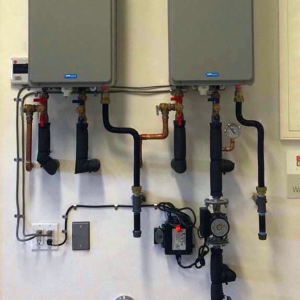
You turn on the hot-water faucet and wait.
Cold water comes out first. Then lukewarm water. Eventually, the hot water you wanted finally reaches the fixture.
That delay is not necessarily a problem with your water heater. In many homes, the real issue is the distance between the water heater and the faucet, shower, or appliance you are using. The water sitting inside the hot-water piping cools between uses, and that cooled water has to move out of the line before freshly heated water can arrive.
A hot water recirculation system is designed to solve that problem by moving water through the plumbing so hot water can be available at fixtures faster—without sending as much usable water down the drain while you wait.
But not all recirculation systems work the same way.
Some circulate continuously. Some operate on schedules. Some try to predict when you will need hot water. Others operate only when hot water is requested.
Understanding those differences is important because the way a recirculation pump is controlled can affect water use, energy use, comfort, pump runtime, and the overall performance of the system.
Quick Answer: What Is a Hot Water Recirculation System?
A hot water recirculation system uses a pump to move water through a home’s hot-water plumbing so heated water can reach fixtures faster.
Depending on the plumbing design, the water can return to the water heater through a dedicated return line or, in some retrofit systems, temporarily use the existing cold-water piping as the return path.
The biggest difference between systems is when the pump runs.
A continuous system may circulate for long periods. A timer runs according to a schedule. A temperature-controlled system responds to water temperature. A demand-controlled system activates when someone actually requests hot water and then shuts the pump off once the circulation cycle is complete.
For many homeowners, the goal is simple:
Get hot water where you need it without running the recirculation pump when you do not need it.
Hot Water Recirculation at a Glance
| Question | Short Answer |
|---|---|
| What does a recirculation system do? | Moves water through the plumbing so hot water reaches fixtures faster. |
| Does a recirculation pump heat the water? | No. The water heater heats the water; the pump moves it. |
| Do I need a dedicated return line? | Not necessarily. Systems are available for homes both with and without dedicated return piping. |
| Can recirculation work with a tankless water heater? | Yes, when the system is properly selected and configured for the water heater and plumbing. |
| Can it work with a heat-pump water heater? | Yes. Compatible demand-controlled configurations are available. |
| Does the pump have to run all day? | No. Demand-controlled systems are specifically designed to avoid unnecessary continuous operation. |
| Do I always need a new pump? | No. Some compatible existing recirculation pumps can be upgraded with a demand controller. |
| What determines how quickly hot water arrives? | Pump performance, pipe size and length, plumbing configuration, restrictions, water-heater characteristics, and other installation conditions. |
Why Does Hot Water Take So Long to Reach the Faucet?
Your water heater and your faucet can be separated by a surprisingly large amount of plumbing.
Imagine that your water heater is in the garage while your primary bathroom is on the opposite side of the house. The pipe connecting the two locations may contain a significant volume of water.
After you finish using hot water, the water remaining inside that pipe begins to cool.
The next time you open the hot-water faucet, that cooled water comes out first. Only after it leaves the pipe can newly heated water from the water heater reach you.
The farther the fixture is from the water heater—and the more water stored inside the piping—the longer the potential wait.
Several factors influence the wait:
- Length of the hot-water piping
- Pipe diameter
- Plumbing layout
- Fixture flow rate
- Water-heater location
- Water-heater type
- Pump flow and available head
- Restrictions in the plumbing system
This is why replacing the water heater alone does not necessarily eliminate a long wait for hot water.
A tankless water heater, for example, heats water on demand, but the hot water it produces still has to travel from the heater through the home’s plumbing to the fixture.
Producing hot water and delivering hot water are two different jobs.
The water heater produces it.
The plumbing and, when installed, the recirculation system deliver it.
Why Waiting for Hot Water Wastes Water
Without recirculation, many homeowners simply turn on the faucet or shower and let the water run until it becomes hot.
That water may still be perfectly usable potable water. It simply is not yet at the temperature the user wants.
Once it disappears down the drain, however, it has been consumed without accomplishing the intended task.
The amount varies dramatically from home to home.
A useful way to estimate your own household’s potential waste is:
Fixture flow rate × waiting time × number of hot-water waits
For example, a fixture with a relatively high flow rate and a long hot-water run can send much more water down the drain during the wait than a low-flow fixture located close to the water heater.
This is one reason efficient hot-water distribution has become an important part of water-efficient home design.
The U.S. Environmental Protection Agency’s WaterSense program recommends designing hot-water distribution systems to minimize the amount of water stored between the hot-water source and the end use. Its current guidance also identifies demand-initiated recirculation as an option for efficient hot-water delivery.
How Does a Hot Water Recirculation Pump Work?
A recirculation pump creates water movement through the hot-water distribution system.
Instead of waiting for cooled water to leave through an open faucet, the system moves water through a circulation path.
There are two common residential plumbing configurations.
1. Recirculation With a Dedicated Return Line
A dedicated return line creates a loop.
Hot water leaves the water heater through the home’s hot-water supply piping. A separate return pipe allows water from the end of the hot-water loop to travel back toward the water heater.
This configuration is especially practical during new construction or major remodeling because the additional return piping can be planned before walls are closed.
The pump may be installed at or near the water heater depending on the system design.
A dedicated return line can provide an efficient plumbing path, but the presence of a return line does not determine whether the system itself operates efficiently.
The control strategy still matters.
A pump on a dedicated return line could run continuously, operate on a timer, follow temperature settings, use predictive controls, or operate on demand.
2. Recirculation Without a Dedicated Return Line
Many existing homes were never built with a hot-water return pipe.
That does not automatically mean recirculation is impossible.
Certain retrofit systems can use the home’s existing plumbing to create a temporary circulation path, avoiding the need to open walls and install a dedicated return line throughout the home.
D’MAND Kontrols® ACT2-BTR configurations, for example, are designed for applications without a dedicated return line and are installed under a common kitchen or bathroom sink.
This can make on-demand recirculation practical in existing homes where adding new return piping would otherwise be disruptive.
The Five Main Ways Hot Water Recirculation Systems Are Controlled
This is where homeowners should pay especially close attention.
Two systems may both contain a recirculation pump but operate in completely different ways.
Continuous Recirculation
A continuous system keeps water circulating for extended periods.
The advantage is obvious: the plumbing loop is regularly supplied with hot water.
The disadvantage is that continuously moving hot water through piping can increase pump runtime and distribution heat loss compared with operating the pump only when circulation is actually needed.
Timer-Based Recirculation
A timer attempts to improve on continuous circulation by operating the pump during predetermined periods.
You might program it to run before people normally shower in the morning and again during the evening.
This can reduce unnecessary operation compared with 24-hour circulation.
The limitation is equally obvious: people do not always live according to a timer.
A late shower, an unexpected guest, a changed work schedule, a vacation day, or a middle-of-the-day need for hot water may fall outside the programmed period.
Conversely, the pump may operate during a scheduled period even when nobody needs hot water.
Temperature-Controlled Recirculation
Temperature-based systems operate in response to the temperature of the water in the recirculation loop.
When the loop cools below a set threshold, the pump can run to restore temperature.
This helps maintain temperature in the plumbing but can cause circulation even when nobody is about to use hot water.
Smart or Predictive Recirculation
Some modern systems attempt to learn household patterns.
If the system notices that someone frequently needs hot water at approximately the same time each morning, it can anticipate that usage.
This can provide convenience while reducing some unnecessary runtime.
Prediction, however, is still prediction.
Changes in schedule can create periods when the system prepares hot water that nobody uses or fails to anticipate an unusual hot-water request.
Demand-Controlled Recirculation
Demand-controlled—or demand-initiated—recirculation takes a different approach.
Instead of continuously maintaining hot water in the pipes or trying to predict when someone might need it, the system activates when hot water is actually requested.
With D’MAND Kontrols®, activation can be initiated through compatible controls such as a button, motion sensor, or Bluetooth-enabled control option, depending on the system configuration.
The pump moves water through the circulation path. Temperature sensing and the controller monitor the circulation cycle, and the pump is shut off automatically when the appropriate temperature change is detected.
The concept is straightforward:
Request hot water → circulate the water → detect the temperature change → stop the pump.
The pump does not need to run simply because the clock says it is 7:00 a.m.
It runs because someone has actually requested hot water.
That distinction is one of the most important things to understand when comparing recirculation systems.
On-Demand vs. Timer vs. Continuous Recirculation
| Control Method | When the Pump Runs | Key Advantage | Main Tradeoff |
|---|---|---|---|
| Continuous | For long or continuous periods | Hot loop is regularly maintained | Greater potential pump runtime and distribution heat loss |
| Timer | During scheduled periods | Reduces operation outside scheduled times | Schedule may not match actual hot-water use |
| Temperature | When loop temperature falls | Maintains loop temperature | Can circulate without actual user demand |
| Predictive/Smart | Based on learned patterns | Adds automation | Household behavior can change |
| Demand-Controlled | After an actual hot-water request | Avoids maintaining circulation solely for anticipated use | User or sensor activation must initiate the cycle |
Demand control is not magic; it is simply a different control philosophy.
Instead of asking:
“When do we think someone might need hot water?”
it asks:
“Has someone requested hot water?”
Does a Recirculation System Give You Instant Hot Water?
The phrase “instant hot water” is commonly used in the industry, but it is important to understand what a recirculation system can and cannot do.
A controller can determine when the pump operates.
It cannot eliminate the physical distance between the water heater and the fixture.
When a demand-controlled system is activated, the pump still needs time to move water through the plumbing.
How quickly the hot water reaches the fixture depends on factors including:
- Pump flow performance
- Available pump head
- Pipe length
- Pipe diameter
- Plumbing restrictions
- System configuration
- Water-heater characteristics
That means two homes using the same controller can experience different delivery times.
A shorter plumbing run with favorable flow conditions may deliver hot water considerably faster than a large home with long piping runs and a lower-flow pump.
This distinction is especially important for homeowners who already have a recirculation pump.
Already Have a Recirculation Pump? You May Not Need to Replace It
Some homeowners already have a functional recirculation pump but want better control.
In that situation, replacing the entire system may not always be necessary.
If the existing pump is compatible with the application, a demand controller may be able to change how that pump operates.
The ACT KONTROLS2-BTR, for example, is designed to convert a compatible standard residential recirculation pump into a D’MAND-controlled system.
That means homeowners may be able to begin gaining the benefits of demand control while continuing to use their existing compatible pump.
There is one important limitation to understand:
The controller controls the pump. It does not change the pump’s hydraulic performance.
If the existing pump moves water more slowly than the homeowner prefers, the control system can still reduce unnecessary pump operation and help reduce water normally wasted while waiting.
If faster delivery is desired later, the homeowner can evaluate whether a higher-performing compatible pump makes sense for the plumbing system.
In other words:
You do not necessarily have to replace a working pump just to gain demand control.
And if the pump is replaced later, the new pump can be selected based on the performance requirements of the home.
What Actually Determines How Fast Hot Water Arrives?
Homeowners often assume the controller determines the speed of delivery.
It does not.
Think of the controller as the decision maker and the pump as the mover.
The controller decides when the circulation cycle starts and stops.
The pump provides the hydraulic force that moves water.
Several variables work together.
Pump Flow
A pump capable of moving more water under the actual system conditions can often move heated water through the piping more quickly.
But looking at a pump’s advertised maximum flow alone is not enough.
Pump Head
Every plumbing system creates resistance.
Pipe length, fittings, valves, elevation, diameter, and other components affect how much flow the pump can actually produce.
Pump selection should therefore consider both flow and head.
Pipe Length
Longer piping runs contain more water.
More stored water generally means more volume has to be moved before heated water reaches the destination.
Pipe Diameter
Larger-diameter pipe can hold significantly more water per foot than smaller pipe.
That can affect both waiting time and the amount of water contained within a hot-water run.
Water-Heater Characteristics
Tank, tankless, and heat-pump water heaters operate differently.
The recirculation system needs to be selected and configured appropriately for the water-heating equipment.
This is particularly important with tankless systems, where flow requirements and manufacturer installation requirements should be considered.
Can a Hot Water Recirculation System Work With a Tank Water Heater?
Yes.
Conventional storage-tank water heaters are commonly used with hot-water recirculation systems.
The key decisions are not simply whether the home has a tank heater, but:
- Whether a dedicated return line exists
- How large the home is
- How long the plumbing runs are
- What pump performance is needed
- How the homeowner wants the system activated and controlled
Can You Use Hot Water Recirculation With a Tankless Water Heater?
Yes, when the recirculation system and plumbing are properly designed for the tankless heater.
A common misunderstanding is that installing a tankless water heater automatically eliminates the wait for hot water.
It does not.
“Tankless” describes how the water is heated—not the distance between the heater and the faucet.
The water still has to travel through the plumbing.
A homeowner can therefore have a high-performance tankless water heater and still experience a significant delay at a distant bathroom.
Recirculation can address the distribution problem, while the tankless heater addresses the water-heating problem.
Always follow the water-heater manufacturer’s installation requirements and select a recirculation solution appropriate for the specific equipment and plumbing configuration.
Can Recirculation Work With a Heat-Pump Water Heater?
Yes.
Heat-pump water heaters are increasingly popular because of their water-heating efficiency, and compatible recirculation configurations are available.
Control strategy can be particularly important in an energy-conscious installation because unnecessarily circulating hot water through piping can create avoidable distribution heat loss.
Current ACT2 dedicated-return configurations are designed for applications up to 4,000 square feet with heat-pump, tankless, or tank-type water heaters, subject to proper system selection and installation.
The objective is not simply to add a pump.
It is to coordinate the water heater, plumbing distribution system, pump, and control strategy.
Do You Need a Dedicated Return Line?
No.
A dedicated return line is useful and can be an excellent choice, especially during new construction.
But homeowners with existing plumbing should not assume they have to tear open walls and install a new return pipe just to use recirculation.
D’MAND Kontrols® offers solutions for both conditions:
Homes with dedicated return piping: The recirculation loop can return water through the dedicated line.
Homes without a dedicated return line: Selected retrofit systems can use the existing plumbing to create the circulation path.
This is one of the first questions to answer when selecting a system.
If you are unsure whether your home has a dedicated return line, a plumber or D’MAND Kontrols® representative can help determine which configuration applies.
How Does Demand-Controlled Recirculation Save Water?
The water-saving concept is straightforward.
Without recirculation:
- You turn on the hot-water faucet.
- Cooled water sitting in the hot-water pipe flows down the drain.
- You continue waiting.
- Hot water eventually reaches the fixture.
With demand recirculation:
- You request hot water.
- The pump moves water through a circulation path.
- The system stops the pump when the circulation cycle is complete.
- You use the fixture after hot water has been brought closer to the point of use.
Instead of intentionally dumping the cooled water from the hot-water line down the drain while waiting, the water remains within the plumbing system.
Actual savings vary because every home and household is different.
ACT estimates that D’MAND systems can save approximately 8,000 to 12,000 gallons of water annually per household in applicable installations, but actual savings depend on household behavior, fixture flow rates, plumbing layout, wait times, and system use.
The most useful calculation is therefore not a national average.
It is your own home’s current wait time and flow rate.
Does a Hot Water Recirculation Pump Save Energy?
The answer depends heavily on how the system is designed and controlled.
Recirculation is not automatically energy-efficient simply because a pump is installed.
When hot water is continually circulated through piping, heat can escape from those pipes into the surrounding building.
A pump that runs when nobody needs hot water also consumes electricity unnecessarily.
This is why control strategy matters.
EPA WaterSense guidance specifically notes that demand-activated recirculation can help prevent recirculation from unnecessarily increasing the energy used to heat water.
Demand control is designed to minimize unnecessary circulation by operating when hot water is actually requested and shutting the pump back down after the circulation cycle.
Pipe insulation also remains important.
Demand control and good pipe insulation address different parts of the same efficiency problem:
Control reduces unnecessary circulation.
Insulation reduces heat loss from the water that is in the piping.
How Do D’MAND Kontrols® Systems Work?
ACT, Inc. has been developing D’MAND® hot-water recirculation technology since 1992.
The basic philosophy is simple:
Do not keep the recirculation pump running when nobody is asking for hot water.
When activated, a D’MAND Kontrols® system initiates a circulation cycle.
The pump moves water through the plumbing, while the system’s temperature sensing and proprietary Delta-T control technology monitor the change in water temperature.
Once the required temperature change is detected, the controller shuts the pump off.
This approach allows the pump to respond to an actual demand rather than simply circulating according to a fixed schedule.
Depending on the selected configuration, activation options can include hardwired buttons, motion sensors, and Bluetooth-enabled controls.
Which D’MAND System Is Right for My Home?
The right system depends primarily on the plumbing—not simply on the square footage listed on a real-estate page.
Start with these questions:
- Do you have a dedicated hot-water return line?
- What type of water heater do you have—tank, tankless, or heat pump?
- How large is the home and how long are the longest plumbing runs?
- Do you already have a functional recirculation pump?
- How would you like to activate the system?
- Are you trying to improve water conservation, delivery time, pump control, or all three?
For many residential applications up to 4,000 square feet with a dedicated return line, the ACT2 family provides multiple activation configurations and is designed for use with heat-pump, tankless, or tank-type water heaters.
Homes without a dedicated return line can use selected ACT2 retrofit configurations, including the ACT2-BTR family.
Larger homes and longer piping applications may require an SS3-series system.
And homeowners who already have a compatible recirculation pump may be able to add D’MAND control with the ACT KONTROLS2-BTR rather than replacing the entire pump system.
Because plumbing systems vary, system selection should be based on the actual installation rather than choosing solely by product name.
New Construction vs. Existing Homes
If You Are Building a New Home
New construction provides the greatest opportunity to optimize the entire hot-water distribution system.
The builder can:
- Locate the water heater strategically
- Minimize unnecessary pipe volume
- Create compact plumbing layouts
- Install appropriate pipe insulation
- Incorporate a dedicated return line where appropriate
- Specify demand-controlled recirculation from the beginning
This matters because the most efficient hot-water system is not simply a better water heater.
It is an efficient water heater + distribution system + control strategy.
EPA WaterSense specifically encourages efficient hot-water distribution design and uses low stored-water volume as an important design objective.
If You Already Own the Home
You still have options.
A retrofit demand-controlled system may make it possible to improve hot-water delivery without installing a new dedicated return pipe throughout the house.
And if your home already has a recirculation pump, upgrading the controls may be another option.
That means the first step should not automatically be:
“Replace everything.”
It should be:
“What equipment and plumbing do I already have, and what actually needs to change?”
What Should You Look for When Choosing a Recirculation System?
A good buying decision goes beyond pump price.
Consider the complete system.
Control Strategy
Does the pump run because someone wants hot water, or because a timer or temperature setting tells it to run?
Plumbing Compatibility
Does the home have a dedicated return line?
If not, is the system specifically designed for retrofit use?
Water-Heater Compatibility
Confirm that the system configuration is appropriate for your tank, tankless, or heat-pump water heater.
Pump Performance
Make sure the pump is suited to the plumbing run, required flow, and system head.
Activation Options
Consider how your household actually lives.
Would you prefer a button?
Motion activation?
Bluetooth control?
A combination?
Temperature Control
A demand-controlled system should know when the circulation cycle can stop instead of relying exclusively on a fixed runtime.
Installation Support
Look for clear installation instructions, specifications, technical support, and access to knowledgeable professionals.
Long-Term Flexibility
If you already own a functional compatible pump, find out whether you can upgrade the controls instead of replacing equipment unnecessarily.
Common Hot Water Recirculation Myths
Myth: A tankless heater gives you instant hot water everywhere.
A tankless heater produces hot water without storing it in a conventional tank. The hot water still has to travel through the home’s piping.
Myth: Every recirculation pump runs continuously.
No. The pump’s operating behavior depends on the controller.
Myth: You must have a dedicated return line.
Not necessarily. Retrofit systems are available for homes without dedicated return piping.
Myth: A faster controller makes water move faster.
The controller determines when the pump operates. Pump performance and plumbing conditions determine how quickly the water physically moves.
Myth: If you already have a pump, you have to replace it.
Not always. A compatible existing pump may be able to operate with a demand controller.
Myth: Bigger pumps are always better.
Pump selection needs to match the plumbing system. Flow, head, pipe size, length, heater requirements, and installation conditions all matter.
Frequently Asked Questions About Hot Water Recirculation Systems
What is the main purpose of a hot water recirculation system?
The main purpose is to reduce the time and water normally lost while waiting for heated water to travel from the water heater to a fixture.
Does a hot water recirculation pump make my water hotter?
No. The water heater determines water temperature. The recirculation pump moves water through the plumbing.
How long does a recirculation pump take to bring hot water to a fixture?
There is no universal time. Delivery depends on pump flow, system head, pipe length, pipe diameter, plumbing configuration, water-heater characteristics, and other installation conditions.
Is on-demand recirculation different from a timer?
Yes. A timer operates according to a preset schedule. A true demand-controlled system initiates circulation in response to an actual hot-water request.
Can I install recirculation in an older home?
In many cases, yes. Systems designed for homes without dedicated return lines can make retrofit installation possible without running a new return pipe throughout the house.
Can I keep my existing recirculation pump?
Possibly. If the pump is compatible and appropriate for the plumbing system, a controller such as the ACT KONTROLS2-BTR may be able to convert it to D’MAND-controlled operation.
Will upgrading the controller make my existing pump deliver water faster?
Not necessarily. The controller changes when and how the pump operates. The pump’s hydraulic performance still determines how quickly it can move water through the plumbing.
Can D’MAND Kontrols® work with tankless water heaters?
Yes, selected D’MAND configurations are designed for tankless applications. The correct model should be selected according to home size, piping length, plumbing configuration, and water-heater requirements.
Can D’MAND Kontrols® work with heat-pump water heaters?
Yes. Current ACT2 dedicated-return configurations include applications using heat-pump water heaters when properly selected and installed.
Does hot-water recirculation eliminate all water waste?
No plumbing system can eliminate every form of household water waste. Demand recirculation specifically addresses the water normally sent down the drain while waiting for hot water to travel through the distribution piping.
The Bottom Line
A hot water recirculation system is about more than convenience.
It is about how your home delivers the hot water your water heater has already produced.
The best system for your home depends on your plumbing configuration, water-heater type, pipe length, pump performance, and how you want the system controlled.
And the controller matters.
Continuous systems maintain circulation for long periods.
Timers operate according to schedules.
Predictive systems try to anticipate your behavior.
A demand-controlled system waits for something much simpler:
You.
When you request hot water, the system circulates it. When the circulation cycle is complete, the pump shuts off.
That is the idea behind D’MAND Kontrols®.
Hot water on D’MAND—without running the recirculation pump when you do not need it.
Not Sure Which Hot Water Recirculation System Fits Your Home?
You do not need to know every detail about your plumbing before contacting us.
Tell the D’MAND Kontrols® team:
- What type of water heater you have
- Whether you believe you have a dedicated return line
- Approximate home size
- Whether you already have a recirculation pump
- Which fixture takes the longest to receive hot water
We can help identify the appropriate D’MAND Kontrols® configuration for your plumbing system.
Explore Residential D’MAND Kontrols® Systems
Already Have a Recirculation Pump? Explore D’MAND Controller Options
Contact D’MAND Kontrols® for System Selection Help
ACT, Inc. D’MAND Kontrols® has developed hot-water recirculation solutions since 1992. System performance and water or energy savings vary based on plumbing configuration, equipment, household behavior, installation conditions, utility rates, fixture flow rates, and other factors. Product selection and installation should comply with applicable codes and equipment-manufacturer requirements.